
Running Roadblocks

It was the summer between 10th and 11th grade and sections of our foothill town were ablaze. Hot days and drought had turned the pine, oak and manzanita covered hills around my family home into a tinderbox.
My parents were on vacation. Officially, I was being supervised by Grandma Alice, who lived a few miles up the road. She’d stopped by only a morning earlier to discover my friends crashed out in the living room with beer cans strewn about. After shooting me a stern look of disapproval she’d helped clean up the mess and dispose of the evidence.
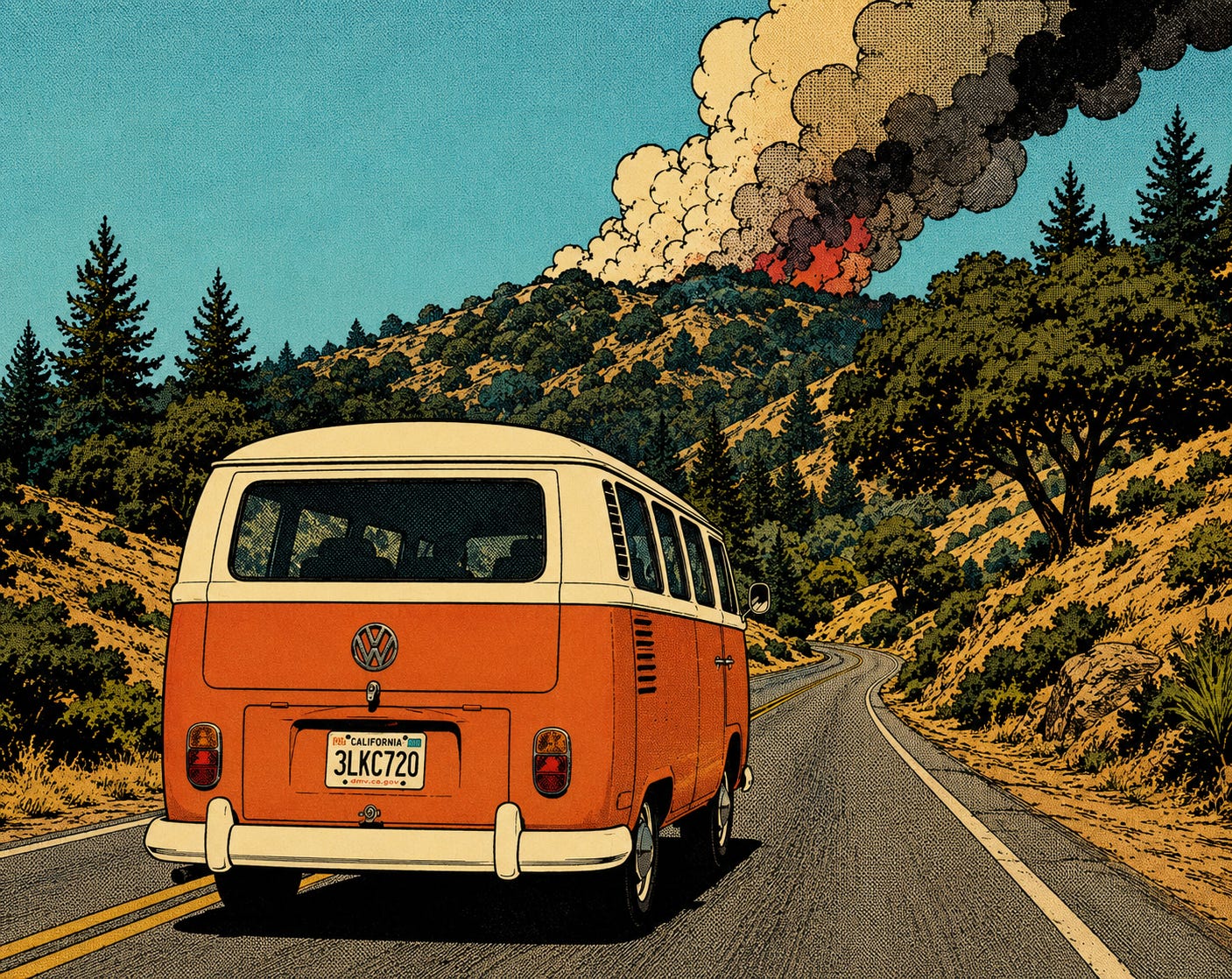
I was in the kitchen eating my Honey Nut Cheerios and reading the sports section when Grandma Alice opened the door yelling about the fire.
“Are you watching?” she asked urgently.
“Watching what?” I asked.
“The flames!” she barked, pointing toward our side window.
Sure enough the hillside, barely a stone’s throw from our house, was on fire. Flames whipped through trees on a hot gusty breeze and several firefighters fought to contain it without being swallowed up.
“Let’s get the hoses. We need to fill some buckets. And spray the house down.” Grandma Alice was moving as fast as I’d ever seen her go. I jumped into action too.
“I can’t believe this is happening again,” she said, recalling the close call with a fire she’d endured 30 years earlier at the family ranch.
As we worked to fill buckets and water down the yard, Grandma Alice informed me that her own house was right in the heart of the fire zone and probably lost, along with her two pet cats. She’d tried to race home when she’d heard about the spreading fire but was stopped at a roadblock and denied access.
Over the next hour or two, mercifully, the fire near our house seemed to recede with the firefighters steering it away from homes and over an empty ridge. Grandma Alice went inside to make some phone calls.
It was about this time that Dustin and Lee arrived at my house in Lee’s dad’s orange and white Volkswagen passenger van. Dustin was shirtless and both of them were sunburned from a morning swimming at the river. It was clear immediately they were dangerously bored, in the way only unsupervised 16-year-old boys in the middle of a hot summer’s day can be.
We talked about the fire and I told them about my grandma’s predicament—not being able to get to her cats—and somewhere in the conversation Dustin and Lee decided they were going to rescue the stranded pets.
They drove off, only to return minutes later with news that they were turned away by a police roadblock—a cop parked along the highway frontage road who’d told them they had to turn around.
“We should have just driven past him,” Dustin said, smiling.
“I know,” Lee said, “His hood was up. I think his car was overheating anyway.”
“Let’s go back,” Dustin said. “He might be gone. Worst case we just act like we don’t see him.”
Inexplicably I agreed to join them for what I assumed would be little more than a slightly dangerous fact-finding mission. Just before we climbed into the van, Dustin walked over and draped his t-shirt over the van’s license plate.
“Just in case,” he laughed.
With that, we headed down the hill.
Lee was at the wheel. Dustin was in the passenger seat and I was in the back. As we approached, the cop car came into view and my pulse quickened—not because I expected Lee to run the roadblock—but because I anticipated the police officer might be more than a little frustrated by having to turn the same van full of teenagers around for the second time.
For a few seconds I didn’t see the cop, then he appeared on our left—walking out with his hand up and an incredulous expression on his face. Lee was slowing, moving at perhaps 10 miles per hour when Dustin yelled “Go!” And with that, Lee stepped on the gas and took a wide sweeping turn around the cop and cop car.
The Volkswagen van’s air-cooled engine puttered like a sewing machine as it accelerated laboriously. We all did our best not to look at the cop, but I couldn’t help myself. I peered out the curtained side window just as his raised hand turned to a fist and he punched the side of the van near my head. And then, in what I took as a much, much worse turn of events, after striking the van, the police officer slipped and fell to the ground.
“He fell down,” I shrieked.
“Go! Go! Go!” Dustin implored Lee, who was already giving the van all he could.
It was in this stretch of road, in the ten seconds after we passed the officer, that I experienced the first several stages of grief in approximately the time it took the Volkswagen to hit thirty miles an hour.
Denial: This isn’t happening.
Anger: What is Lee doing?
Bargaining: Please let us get away. I swear I’ll never do anything like this again.
Then we rounded the bend right where the frontage road meets the highway to discover a truly horrific site—the main staging area for all of the emergency services. There were multiple fire trucks, an ambulance, television news media vans, and several sheriff’s department vehicles.
As we rolled into the maze of emergency trucks, like caged rats desperate for an exit, we were approached by a slightly confused looking sheriff.
“How’d you get up here? I need you to turn it around.”
“No problem!” Lee said quickly, as we all quietly considered the prospect of driving back toward the same cop we’d last seen on the ground.
Then an officer holding a radio yelled out, “Hey! Stop that vehicle.” Game over.
One of the deputies approached the van asking something, but his question was drowned out by the sound of a police car racing up and skidding to a stop. It was the roadblock cop—his car seemed to be working fine now. He ran to Lee’s driver door and reached through the window grabbing him by the shirt.
Lee was clearly surprised by the aggression and he yelled out, “What are you going to do? Hit me?”
“I’ll do worse than that!” the cop replied, and he pulled Lee halfway through the window as the door swung open with Lee folded over it. Dustin and I exchanged glances that said, “Well, this is taking a turn for the worse.”
As we sat in the back of separate police vehicles I watched the news cameras—which to this point had been focused on the fire response—turn toward the new commotion—us. Channel 3 news aimed their lens at Lee in the back of a police car and I could see him flip the camera off.
Outside the authorities huddled. Eventually an officer came to my truck and leaned in to read me my rights and inform me we were being arrested not only for assault with a deadly weapon, but also on suspicion of arson.
What? Arson? Although it was clear to me Lee had tried to avoid the cop, I could imagine why he was angry enough to claim to the other cops that we’d tried to run him over. But where did arson come from?
It was only later I realized the police extrapolated—understandably—that the only thing that might explain our spectacularly stupid behavior (even going so far as to cover the license plate) was that we’d started the fire, assumed the roadblocks were set for us, and we were trying to escape.
Before long we’d traded the smoke, sirens, and television cameras for two Sheriff’s Department holding cells—Dustin and I in one, Lee in another. I think the cops were beginning to figure out that Lee, the mouthy driver, belonged in a category all his own.
At some point the officers produced a solitary, soiled looking firecracker they claimed they’d found among the cracks inside Lee’s van and cited it as additional evidence of arson. While I knew none of us had anything to do with arson, I had no trouble imagining there might be a firecracker floating around in Lee’s van. This was the same van involved in countless shenanigans. But Lee objected loudly, almost theatrically, probably mostly for our benefit. “That’s bullshit! You’re trying to frame me! I’m being framed!”
I was mortified. But Dustin grinned. This was just the sort of excitement he craved. He couldn’t help but join in.
“C’mon baby light my fire...” He sang out suddenly.
“Knock it off!” I said with a death stare.
“We’re being framed!” Lee yelled louder this time.
I put my head in my hands.
Later we were brought, individually, to a separate room for interrogation by both a sheriff and a fire detective. I’ll never forget their first question was about Lee. “What’s the deal with the white haired kid?” they asked.
“I don’t know,” I said. “He just doesn’t like authority.”
They proceeded to tell me they knew I wasn’t involved in arson and that since I wasn’t driving the vehicle, any related charges would likely be reduced. They did, however, suggest I might not know my friends as well as I thought. Maybe their sunburns weren’t from a day at the river but rather from standing next to a fire.
I dismissed this as impossible. “Trust me,” I said, “if they were out committing crimes I’d know about it.”
Since my parents were out of town I was released to the custody of my Uncle Craig—a 6’2” gun-toting, barroom brawler who had more than his share of run-ins with the law. He and I got along great so I was a little surprised by his demeanor when he arrived. The sheriff updated him on the situation and my uncle responded with something like “We’ll take care of this at home.”
The cop seemed slightly taken aback. Where he’d started off telling my uncle why I was in trouble, now he was almost defending me.
“Well, he wasn’t driving. And he’s been very cooperative.”
“Go get in the car,” my uncle pointed to the door.
I sat in the truck with my aunt in silence, awaiting my angry uncle—awaiting the lecture, or worse. Instead he climbed behind the wheel, grinned and asked,
“How’d I do?”
I exhaled.
A day or two later Dustin somehow made a cassette recording of the television news report about our arrest. Proud of our newfound notoriety, he copied it onto my answering machine.
“Three local teenagers were arrested today...”
My parents, blissfully vacationing and still completely unaware of any of this, called home and heard the message.
Years later my mother admitted her first thought had been:
Please…no. Not Josh. —JC
This is a great story! Did the cats survive? ~J
Some miscreants start young.